
01 Best overall for older adults
Hyper Vest® PRO Weight Vest
- Weight
- 10–40 lb (max by size)
- Steps
- 2.25 oz
- Price
- $$$
Fine steps and a close, clothing-like fit with more capacity than the ELITE.
Researched pick · Specs checked Oct 8, 2026.
What studies show about weighted vests for adults 65+, how heavy to start, when to stop, and four research-based picks that start light and go on easily.
Our picks at a glance
| Pick | Weight | Steps | Price | Link |
|---|---|---|---|---|
| Best overall for older adults Hyperwear Hyper Vest® PRO Weight Vest | 10–40 lb (max by size) | 2.25 oz | $$$ | Check price |
| Lightest start Hyperwear Hyper Vest FIT Weighted Vest for Women | 0.5–10 lb | 0.5 lb | $$ | Check price |
| Easy on and off OMORPHO G-Vest Icon (Women's) | 6–12 lb | one 6 lb add-on | $$$$ | Check price |
| Best budget Zelus Classic Adjustable Weighted Vest X | 4–32 lb (by version) | 1.5 lb | $–$$ | Check price |
Price: $ under $75 · $$ $75–150 · $$$ $150–250 · $$$$ over $250 (list prices seen at the maker; prices change). Researched picks based on maker specs, expert reviews and owner feedback.
Fine steps and a close, clothing-like fit with more capacity than the ELITE.
Researched pick · Specs checked Oct 8, 2026.
Women's cut with no weight on the chest and half-pound steps – an easy way to start light.
Researched pick · Specs checked Oct 8, 2026.
Body-hugging, low-profile design that experts rate as very comfortable – but expensive and only two weight levels.
Researched pick · Specs checked Oct 6, 2026.
Low price, removable weight bags and an X-shaped harness that keeps pressure off the chest.
Researched pick · Specs checked Oct 9, 2026.
A weighted vest makes walking and simple strength exercises a little harder. In small studies of older adults (Mierzwicki 2019, Roghani 2013), vest exercise programs improved some strength and balance measures. It does not replace medical care. Start very light, ask your clinician first if you have bone, heart, back or balance problems, and choose a vest that is easy to put on.
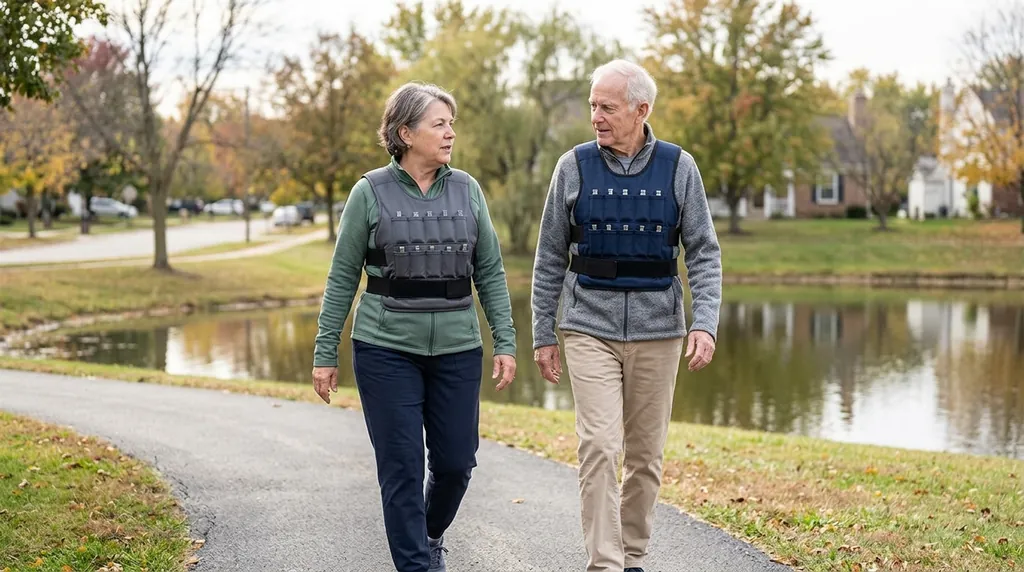
Often yes, if a clinician agrees, you start very light, and you wear it only for planned exercise. That is our reading of the sources, not a medical rule.
In a 12-week trial of 17 adults with a mean age of 68.7, people exercised in a vest at 10% of body weight with no injuries (Mierzwicki 2019). Trial participants were screened and mostly supervised.
Check with a clinician first if you have any of these. Some of the sources named advise against vests altogether:
UCLA Health adds that vests are not for exercise beginners.
Osteoporosis: sources differ. Atlantic Health advises speaking with your medical provider first if you have a history of osteoporosis. UMiami says to avoid vests with severe osteoporosis. Osteoporosis Canada and Hinge Health give conditional advice, not a ban. Talk to your doctor or physical therapist first.
Bone. A 2026 meta-analysis pooled 9 randomized trials with 368 middle-aged and older adults (Wang 2026). Vest plus exercise improved hip and spine bone density compared with usual activity. Certainty was low to moderate, and the gain may come mostly from the exercise. Adding a vest to the same exercise showed no confirmed extra benefit, and only one study tested that.
Osteoporosis Canada (Lora Giangregorio, PhD) is more skeptical. It finds “little to no evidence” that wearing a vest in daily life or on walks raises bone density.
Wearing it for hours. The INVEST trial followed 150 adults with obesity (mean age 66, 75% women) on a 12-month diet (INVEST). Wearing a vest about 7 hours a day did not reduce hip bone loss compared with diet alone. Muscle results also did not differ (INVEST muscle analysis). A 2026 follow-up analysis hinted that the vest may change how upright time relates to bone loss (Fanning 2026). It was exploratory, relied on self-reported wear, and does not show the vest protects bone. In 62 adults (mean age 74), wearing a 3–5% vest 2 hours a day for 27 weeks, without exercise, changed neither bone markers nor strength (Greendale 2000).
Strength and function. In the 12-week trial above, exercise with a 10% vest improved 5 of 12 measures more than the same exercise without it, including chair rises. In 45 mobility-limited adults aged 65 and older, 12 weeks of weighted stair climbing raised leg power more than walking (Bean 2002). We could not verify the vest load. In a non-randomized 8-week pilot of 19 frail nursing-home residents (mean age 86, six in the vest group), function did not improve (Vila 2026).
Balance. In 36 women with osteoporosis, 6 weeks of walking in a 4–8% vest improved balance more than walking without one (Roghani 2013). In a pilot of 34 adults aged 55 and older, a 10 or 20 lb vest did not change objective balance (Paniak 2025). No study we found measured actual falls.
Weight regain. In a pilot follow-up of 18 adults (mean age 70), the vest group was still 4.8 kg below baseline after 24 months. The diet-only group was 0.9 kg above it (DeLong 2025). The difference was not significant.
| Outcome | What studies found | Certainty |
|---|---|---|
| Bone density: vest + exercise vs usual activity | Gains at hip and spine, likely mostly from the exercise (Wang 2026: 9 trials, 368 adults) | Low to moderate |
| Bone density: vest added to the same exercise | No confirmed extra benefit (Wang 2026; only one trial) | Not graded: one trial |
| Bone and muscle: vest worn for hours, no exercise | No benefit (150 adults, 12 months; 62 adults, 27 weeks) | Randomized trials, not graded |
| Strength and function | Some gains in progressive programs (17–45 adults, 12 weeks); none in frail residents (19, 8 weeks) | Low: small trials |
| Balance measures | Mixed: better in one 6-week trial, unchanged in a 34-person pilot | Low: small trials |
| Falls | Not measured in any study we found | No evidence |
| Weight regain | Less regain at 24 months, not significant (18 adults) | Very low: pilot |
The first bone rating comes from the meta-analysis; the other ratings are our reading of study size and design.
Disclosure: Kristen Beavers led or co-authored INVEST and the weight-regain study. Hyperwear, which makes two of our picks, lists her as a science advisor. The papers report no competing interests.
Our house guidance is to start at about 3% of body weight. Add about 1% every 1–2 weeks, only if your walk and posture stay the same and nothing hurts. Cap walking at 10%. This is our editorial rule, not a clinical standard.
| Body weight | Start (3%) | Walking cap (10%) |
|---|---|---|
| 120 lb | ~3.5 lb | 12 lb |
| 140 lb | ~4 lb | 14 lb |
| 160 lb | ~5 lb | 16 lb |
| 180 lb | ~5.5 lb | 18 lb |
These figures are our arithmetic.
Clinical sources disagree on where to start:
We keep 3% because it sits in the middle of the senior-specific sources. Beavers told AARP you can start with no weights at all.
Find your number with our weight calculator or read how heavy a weighted vest should be.
Wear it for planned sessions, not all day.
In a diet study of 37 adults aged 65 to 79, people wore vests about 6.7 hours a day. Five reported vest-related back pain or soreness (Normandin 2018).
Watch the heat. The CDC says older adults “do not adjust as well as young people to sudden changes in temperature.” It advises avoiding very strenuous activity in the heat.
More detail: how long to wear a weighted vest.
Hinge Health lists these signs to stop or scale back:
Atlantic Health’s Bharav Patel, DPT, says that if you must change how you walk, the vest is probably too heavy. UMiami says the same about leaning forward or slouching, and warns that a tight vest can affect breathing. Harvard Health and Sharp say to stop if moving is hard or painful.
Bending and twisting. A UK consensus statement on osteoporosis advises against postures “involving a high degree of spinal flexion (especially weighted).” After a vertebral fracture, it limits impact to brisk-walking level. Osteoporosis Canada says a vest raises spinal forces, especially when bending and twisting. Beavers (AARP) says to take the vest off for activities with a lot of bending. CSPI’s Nutrition Action says to take it off for gardening or yoga.
Running and jumping. Our editorial advice: no running or jumping in a vest unless your clinician approves.
Rounded upper back or pelvic floor problems. We found no vest-specific clinical guidance for either, so we could not verify any advice. The only kyphosis study used a small back-placed weight, not a vest, in 12 women over 60 with no control group (Sinaki 2005).
Why: It is unisex, zips up the front per NBC Select, and uses 2.25 oz steel weights, so you can take weights out to start near 3%. Kit Authority’s seniors guide (researched, not tested) names it best premium.
Good to know:
Who it suits: Adults who want a front zip, a close fit and room to progress. Skip it if: Small weights are hard for your fingers. Price band: $$$.
Sources: Hyperwear, NBC Select, Kit Authority, Rogue, OutdoorGearLab. Read our Hyperwear review.
Why: It is sold as an empty shell, adds weight in ½ lb steps, and keeps weight off the chest. BarBend (hands-on) names it best for women and reports “minimal bouncing.” Kit Authority (not tested) pitches it to women over 50 who build up slowly.
Good to know:
Who it suits: Smaller women who want to start with 1 or 2 lb. Skip it if: You will need more than 10 lb. Price band: $$.
Sources: Hyperwear, BarBend, Garage Gym Reviews, Kit Authority
Why: It has a front locking zipper, per BarBend. An NBC Select tester who wore it found it “easy to quickly put on and take off.”
Good to know:
Who it suits: Women with stiff shoulders who can start at 6 lb. Skip it if: You need to start below 6 lb. Price band: $$$$.
Sources: OMORPHO, BarBend, NBC Select, Garage Gym Reviews
Why: The 4–10 lb version is the lowest-cost light start among our picks. Zelus says its X-shape reduces chest and shoulder pressure; that is a maker claim. We found no independent review of this model. NBC Select’s Zelus pick is a fixed-weight version.
Good to know:
Who it suits: Budget buyers trying a vest for the first time. Skip it if: Hook-and-loop straps are hard for your hands. Price band: $.
Sources: Zelus, Zelus refund policy, NBC Select. Read our Zelus review.
CAP 20-lb Adjustable Weighted Vest: Low cost, one size, with clips and small removable packets (0.75 or 1 lb; sources conflict). Garage Gym Reviews and Ruck Authority call it a decent starter, but they and BarBend report fabric wear and shifting or leaking weights. See our CAP review.
Hyperwear Hyper Vest ELITE: Full front zipper per Hyperwear, but it ships preloaded at 10 lb, which may be too heavy to start.
Fixed-weight vests and plate carriers: Not recommended here. Fixed vests allow no small steps; 8 lb is about 5–6% of body weight for many older women. Plate carriers use heavy plates.
Read about weighted vest benefits and side effects, see the best weighted vests for women or all our best weighted vests, and review our medical disclaimer.
That is not established. No study we found counted actual falls. Some small trials improved balance scores, but in a pilot of 34 adults aged 55 and older (Paniak 2025), a 10 or 20 lb vest did not change objective balance measures, even though many people felt steadier.
We don't know yet. In a pilot follow-up of 18 adults with a mean age of 70 (DeLong 2025), the vest group stayed 4.8 kg below starting weight after 24 months, while the diet-only group was slightly above it. The difference was not statistically significant.
Be careful. The CDC says adults 65 and older adjust less well to sudden temperature changes, and some conditions and medicines make heat harder to handle. The CDC advises avoiding very strenuous activity in the heat, so walk in a cooler part of the day or leave the vest at home.