Evidence-based guides · Reader-supported: we may earn a commission from links.How we work →

Best Weighted Vests for Men

Find the best weighted vest for men by use case. Compare fit, starting weight, included load, plate costs, and top picks for Murph, walking, and dips.

We may earn a commission when you buy through links on this page. Disclosure

Our picks at a glance

PickWeightStepsPriceLink
Best overall
Hyperwear Hyper Vest ELITE Weighted Vest
10–25 lb (max by size) 2.25 oz $$$ Check price
Best for workouts
Rogue Fitness Rogue Plate Carrier
up to 40 lb (plates extra) plate pairs $$$ Check price
Best budget
Zelus Classic Weighted Vest X (fixed)
6–30 lb (fixed versions) fixed $–$$ Check price
Best for heavier loads
Titan Fitness Elite Series Weighted Vest (20 / 30 / 40 / 50 / 60 LB)
20–60 lb (by version) 2.5 lb $$–$$$ Check price
Best low-profile
OMORPHO G-Vest Icon (men's / women's)
men 10–20 lb · women 6–12 lb one add-on pack $$$$ Check price

Price: $ under $75 · $$ $75–150 · $$$ $150–250 · $$$$ over $250 (list prices seen at the maker; prices change). Researched picks based on maker specs, expert reviews and owner feedback.

01 Best overall

Hyper Vest ELITE Weighted Vest

Hyperwear · Slim vest

Weight
10–25 lb (max by size)
Steps
2.25 oz
Price
$$$

Very fine steps and a snug, stretchy fit, with more capacity than the FIT.

Researched pick · Specs checked Oct 8, 2026.

02 Best for workouts

Rogue Plate Carrier

Rogue Fitness · Plate carrier

Weight
up to 40 lb (plates extra)
Steps
plate pairs
Price
$$$

Minimal, durable training carrier that two large review sites rank at the top.

Researched pick · Specs checked Oct 6, 2026.

03 Best budget

Classic Weighted Vest X (fixed)

Zelus · Fixed-weight vest

Weight
6–30 lb (fixed versions)
Steps
fixed
Price
$–$$

Budget fixed-weight vest; reviewers report slight bounce when running.

Researched pick · Specs checked Oct 9, 2026.

04 Best for heavier loads

Elite Series Weighted Vest (20 / 30 / 40 / 50 / 60 LB)

Titan Fitness · Pocket vest

Weight
20–60 lb (by version)
Steps
2.5 lb
Price
$$–$$$

Pocket vest with many load options and 2.5 lb steps at a moderate price.

Researched pick · Specs checked Oct 8, 2026.

05 Best low-profile

G-Vest Icon (men's / women's)

OMORPHO · Slim vest

Weight
men 10–20 lb · women 6–12 lb
Steps
one add-on pack
Price
$$$$

Slim, form-fitting vest that reviewers say moves with you – premium price, only two weight levels.

Researched pick · Specs checked Oct 6, 2026.
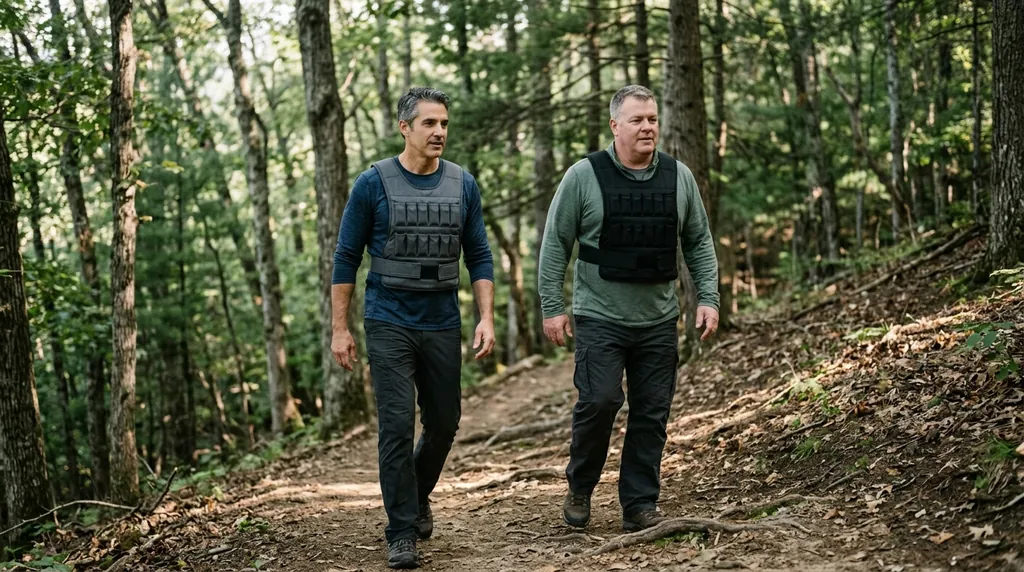
Two men walking up a wooded trail, both wearing weighted vests
AI-generated illustrative image

How we chose these vests

These picks are research-based: they rely on manufacturer specifications, independent expert reviews, and owner feedback. Read more about how we research.

Choose this if:

  • Walking beginner: UCLA Health and Mass General Brigham experts suggest starting around 5% of body weight [1][2]; our house guidance goes lighter (3%) if you are new to exercise. The fixed-weight Zelus Classic is the simplest low-cost path (buy the light version you need now; you cannot add weight later), while the Hyperwear ELITE is the better premium walking option for closer fit and smaller load changes. For walking, our house guidance caps the load at 10% of body weight (up to 15% for healthy, trained adults), but that is not the starting point.
  • Murph or functional fitness: The Rogue Plate Carrier is the straightforward pick if you want a plate-carrier format for the standard event load. Rogue lists a maximum of 40 lb of plates (20 lb per side), but the practical use case here is the Murph standard, not loading to the vest’s maximum.
  • Heavy calisthenics: Choose the Titan Elite if you want an included-weight vest and your real ceiling is within its largest 60 lb version. Choose a plate-owning alternative like the Kensui only if you already own Olympic plates and accept the bulk and stability tradeoffs at very high loads.
  • Low-bulk conditioning: The Hyperwear ELITE is the best fit when close body contact and very small load steps matter more than maximum capacity. The OMORPHO G-Vest Icon is the slimmer, simpler option, but with far less progression flexibility.

Quick selection rule for most walkers: if you want the lowest all-in setup cost, pick Zelus; if you want the best published fit range and the smallest usable increments, pick Hyperwear. Rogue can make sense only if you already want a plate carrier for workouts and accept the extra plate purchase.

A weighted vest’s published maximum capacity is not the same as a smart starting load. Experts at UCLA Health [1] and Mass General Brigham [2] suggest starting around 5% of body weight and progressing slowly, while Cleveland Clinic experts say going above 10% adds little benefit but more injury risk [3]. Our house guidance follows that same conservative pattern: walking starts around 5% of body weight, progression is small and gradual, and the walking ceiling is 10%, with healthy, trained adults (and rucking) up to 15%. Example: for a 200 lb man, that means starting around 10 lb (5%), a walking ceiling of 20 lb (10%), and a trained ceiling of 30 lb (15%).

For Murph prep, the relevant target is the event standard: 20 lb for men and 14 lb for women. For heavy calisthenics, practical loading depends on your current numbers, movement quality, and whether you can keep your mechanics unchanged as load rises.

Safe-start and sizing checklist:

  • Measure your chest where the manufacturer instructs, then check torso length if the brand publishes it.
  • Start with unloaded fit testing first, then add weight only after the vest stays in place through walking, squats, and arm swing.
  • First session: keep it short and easy rather than chasing a target load.
  • Progress time before weight for walking; for strength work, progress only when technique is unchanged.
  • Check with a clinician first if you have neck, shoulder, or back pain, arthritis or joint injuries, heart disease, or high blood pressure [2].

Fit, break-in, and long-term safety checklist:

  • Test the vest unloaded, then lightly loaded, before longer sessions.
  • Increase duration gradually rather than jumping to full sessions.
  • Stop adding weight if you have to change how you walk or shift your weight [4]; also back off if chafing worsens or straps pinch at the neck.
  • Inspect closures, pockets, and straps regularly for wear.
  • Our house guidance: reduce weight or stop if pain starts during or after training.

Best overall: Hyperwear Hyper Vest ELITE

Price status: premium; ships with 10 lb preloaded, with extra weight packs sold separately for higher capacities.

The Hyperwear Hyper Vest ELITE is our top choice because it combines very small load increments with a close, breathable fit. Garage Gym Reviews credits it with more range of motion than most vests, and BarBend says its snug, next-to-skin fit limits bouncing, which makes it easier to use for walking and bodyweight work without the bulk of a plate carrier.

Good to know:

  • Weight and steps: Ships with 10 lb and uses 2.25-ounce steel weights. Per the Hyperwear product page, max load depends on size: Small 15 lb, Medium and Large 20 lb, XL 25 lb.
  • Sizes: Published sizing is a real advantage: S 31–35 in chest, M 35–39 in, L 39–43 in, XL 43–57 in (210+ lb, per Hyperwear).
  • Fit: The maker uses a front zipper, open sides with lacing, and two-way-stretch CORDURA fabric; Garage Gym Reviews points to the range of motion, and BarBend to the snug fit and breathable open sides.
  • Returns/warranty: Hyperwear lists a 24-month warranty, a one-time defect replacement, and a 60-day satisfaction guarantee, though returns include a return-label fee.
  • Tradeoffs: BarBend notes the small weights can be fiddly to manage, and Breaking Muscle (2023) flags the premium pricing and lack of a storage pocket.

Who it suits / skip it if:

  • Who it suits: Athletes who want the best fit range here, small progression steps, and a vest that stays close to the torso for walking, calisthenics, and conditioning.
  • Skip it if: You need more than the per-size cap (25 lb on XL), or you want a simpler heavy-load setup without handling lots of tiny insert weights.

Sources: Hyperwear Hyper Vest ELITE product page, Rogue, Garage Gym Reviews, BarBend, Breaking Muscle

See more options in our detailed guide to the best weighted vests for walking.

Best for workouts: Rogue Plate Carrier

Price status: premium; vest ships empty and requires separately sold plates.

The Rogue Plate Carrier is the clear fit for Murph prep and functional-fitness workouts built around the standard vest format. Garage Gym Reviews and BarBend both credit its durable 500D/1000D Cordura build, and GGR’s review calls the design minimal and streamlined, though the true setup cost is higher because the vest does not include plates.

Good to know:

  • Weight and steps: Empty medium vest weight is 1.12 lb; Rogue lists a max of 40 lb of plates (20 lb per side). It uses plate pairs in fixed steps, and plates are sold separately.
  • Sizes: Available in Small, Medium, and Large, but Rogue does not publish chest or torso measurements on the product page.
  • Fit: Adjustable shoulder straps, a waist strap with a short elastic section, and flap closures over the plate pockets keep the design simple and compact.
  • Returns/warranty: Rogue backs it with a Limited Lifetime warranty and a 30-day return window from delivery for unused items in new condition with original packaging.
  • Tradeoffs: Garage Gym Reviews and BarBend both note minimal shoulder padding; GGR’s review flags that plates cost extra, and BarBend notes the design is built around Rogue-branded plates.

Who it suits / skip it if:

  • Who it suits: Athletes training for Murph or similar bodyweight-and-conditioning sessions who want a durable plate-carrier setup and accept fixed plate steps.
  • Skip it if: You want the lowest all-in setup cost, published fit measurements, or longer weighted walks with more shoulder comfort.

Sources: Rogue Plate Carrier, Rogue Return Policies, Rogue Plate Carrier Review 2026, The Best Weighted Vests, The 9 Best Weighted Vests, Rogue Plate Carrier

See more options in our detailed guide to the best weighted vests for workouts.

Best budget: Zelus Classic Weighted Vest (fixed)

Price status: $–$$ depending on weight; weight is built in.

The fixed-weight Zelus Classic Weighted Vest is the easiest low-cost entry point for walking and basic home training, and it is the Zelus model independent reviewers actually covered. You buy one weight and cannot add more later, so pick the load you need now: our house guidance starts around 5% of body weight (3% if you are new to exercise), which for most men points to one of the lighter versions.

Good to know:

  • Weight: Sold in fixed 6, 8, 12, 16, 20, 25 and 30 lb versions filled with iron sand; no steps.
  • Sizes and fit: X-shaped, one size with adjustable buckle straps for 35–45” chests (maker); reflective strips, an armband pouch and a rear mesh pocket.
  • Returns/warranty: Zelus advertises a 1-year warranty only on its homepage (terms not published); returns within 30 days carry a 25% restocking fee for preference returns, and orders from Amazon get no Zelus after-sales support.
  • What reviews say: OutdoorGearLab bought and tested the 12 lb version and rated it 72/100, noting it “bounces slightly while running.” Garage Gym Reviews names a Zelus vest its Best Budget pick (variant not stated), and NBC Select’s Best for Beginners pick (not tested) is a fixed-weight Zelus version.
  • Also available: Zelus sells an adjustable Classic version, which showed a pre-order notice on its page on October 9, 2026 and has no independent review we could find. See our Zelus review.

Who it suits / skip it if:

  • Who it suits: Walkers and home users who want the lowest-cost setup with the weight built in.
  • Skip it if: You want to add weight later, your chest falls outside the 35–45” strap range, or you want a vest for higher-impact training.

Sources: Zelus Classic Weighted Vest X product page, OutdoorGearLab, Garage Gym Reviews, NBC Select

Best for heavier loads: Titan Elite Series Weighted Vest (20 / 30 / 40 / 50 / 60 LB)

Price status: mid-range to premium; weights are included.

The Titan Elite Series is the better heavy-calisthenics choice when your usable ceiling is within 60 lb and you want a ready-to-use vest rather than a plate-loaded system. It gives you smaller jumps than a plate carrier and avoids the need to buy separate plates, though fit information is limited.

Good to know:

  • Weight and steps: Sold in 20, 30, 40, 50, and 60 lb versions, adjustable in 2.5-pound increments with included cast-iron ingots. Buy the version that matches your ceiling; Titan does not make clear whether a lighter version can be upgraded with extra ingots.
  • Sizes: One-size design only; Titan publishes dimensions but no chest sizing.
  • Fit: U-shaped neckline, shoulder cutouts, added shoulder and chest padding, and an adjustable strap help with heavier strength-focused use.
  • Returns/warranty: Titan lists a 1-year warranty and a 30-day return window for unused items, with customer-paid return shipping and a restocking fee.
  • Tradeoffs: BarBend and Garage Gym Lab liked the broad load range and small steps, while BarBend notes the sizing lacks chest measurements and Breaking Muscle (2023) noted bulky ingots, non-adjustable shoulder straps, and seams that may loosen when washed.

Who it suits / skip it if:

  • Who it suits: Athletes doing weighted dips, pull-ups, lunges, and squats who want included weight and practical progression up to 60 lb.
  • Skip it if: You need detailed sizing, a very tight fit for dynamic work, or a vest for movement where bulk and shifting are more noticeable.

Sources: Titan Fitness, Titan Fitness, BarBend, Garage Gym Lab, Sports Illustrated Showcase, Breaking Muscle

See more options in our detailed guide to the best heavy weighted vests.

Best low-profile: OMORPHO G-Vest Icon

Price status: premium; base weight is built in, with the G-Pack add-on sold separately.

The OMORPHO G-Vest Icon stands out for a slim, body-hugging feel that avoids the plate-carrier look and bulk. It is a niche pick: great if you value a sleek fit, less compelling if you need fine progression or heavier loading.

Good to know:

  • Weight and steps: Men’s version ranges from 10 to 20 lb, so there are only two levels: the base vest and the optional +10 lb G-Pack.
  • Sizes: Available in Men’s S-M, L-XL, and XXL, but no detailed chest chart is published.
  • Fit: T3 and Athletech News describe it as slim and form-fitting, and say it moves with you.
  • Returns/warranty: OMORPHO offers a 30-day money-back guarantee with free returns but does not list a formal long-term warranty.
  • Tradeoffs: T3 and Athletech News flag the premium price and the extra cost of the add-on weight, and T3 finds it light for harder workouts.

Who it suits / skip it if:

  • Who it suits: Athletes who care most about a slim fit and lower-bulk feel for conditioning sessions.
  • Skip it if: You want micro-loading, heavier strength work, or the best value per pound of usable load.

Sources: OMORPHO, OMORPHO, T3, Athletech News, NBC Select, Garage Gym Reviews (G-Vest+), BarBend

Also considered

5.11 Tactical TacTec Plate Carrier: Named Best for CrossFit by both Garage Gym Reviews and BarBend, which credit its durable build; GGR’s review also notes good range of motion. We left it out because GGR’s review describes it as bulky and hot, it still requires separately sold plates, and max load and sizing are not stated consistently across sources. Sources: TacTec Plate Carrier, Expert-Tested: 5.11 TacTec Plate Carrier Review, The Best Weighted Vests, The 9 Best Weighted Vests, Rogue weighted vests listing

Kensui EZ-VEST V2: The best alternative if you already own Olympic plates and want far more than 60 lb (capacity per the maker), but Garage Gym Reviews notes it gets awkward at high loads, plates can bounce, and thick plates reduce usable capacity. GGR also says it is not meant for running or CrossFit-style workouts. That is why Titan is the cleaner recommendation under 60 lb, while Kensui is the plate-owning, very-high-load option. Sources: Kensui, Kensui, Kensui, Garage Gym Reviews, Garage Gym Reviews, Garage Gym Reviews, Torokhtiy, Garage Gym Lab

GORUCK Rucking Weight Vest: A purpose-built rucking option; WearTested (which received the vest free) and the Strength Axis blog describe it as stable, including on uneven terrain. We left it out because it requires proprietary curved plates that fit only this vest, its load is capped well below heavier carriers, and independent coverage is thin. Sources: Rucking Weight Vest, Curved Ruck Plates, GORUCK Domestic Returns and Exchanges, The GORUCK Rucking Weight Vest, Rucking Fast and Light, Rucking Weight Vest

MiR Pro Weighted Vests: Garage Gym Reviews and Fitness Volt point to very high capacity with small adjustable steps, but Fitness Volt also calls it expensive and heavy, a bigger commitment than most readers need. Sources: Rogue Fitness, Rogue Support, Garage Gym Reviews, Fitness Volt

CAP Barbell CAP 20-lb Adjustable Weighted Vest: BarBend names it Best Budget for its very low price, but Garage Gym Reviews says the fabric tears easily and BarBend notes the weight can flop around, which makes it a weaker long-term pick than Zelus. Sources: CAP Barbell, BarBend, Garage Gym Reviews, Breaking Muscle

Should men use a weighted vest?

Yes, a weighted vest can be a useful tool for healthy adults who want to make walking or bodyweight training harder without holding dumbbells or kettlebells. But the main rule is simple: capacity is not the same as appropriate training load.

Experts at UCLA Health [1] and Mass General Brigham [2] advise starting light and progressing slowly, and Cleveland Clinic experts say going above 10% of body weight adds little benefit but more injury risk [3]. Check with a clinician first if you have back, neck, or joint problems, heart disease, or high blood pressure [2]. Atlantic Health physical therapist Bharav Patel, DPT, puts it plainly: “If you find that you have to change how you walk or you shift your weight around when wearing a vest, it’s probably too heavy.” [4]

Use-case practical ranges:

  • Walking: Start at about 5% of body weight [1][2]; our house guidance sets the ceiling at 10% (up to 15% for trained adults).
  • Murph prep: The event standard is 20 lb for men and 14 lb for women, so build the bodyweight volume first, then add the vest.
  • Running: Our house guidance does not recommend it by default; experienced, pain-free runners should keep to short segments at no more than 5% of body weight.
  • Heavy calisthenics: Load depends on your training age and movement quality. Manufacturer capacity tells you the vest’s ceiling, not where you should start.

If body composition is part of your goal, treat the vest as a way to make specific sessions harder, not as a shortcut.

Learn more about the specific weighted vest benefits for your training style.

How to pick a weighted vest for men

Pick the vest style that matches both your activity and your realistic load range.
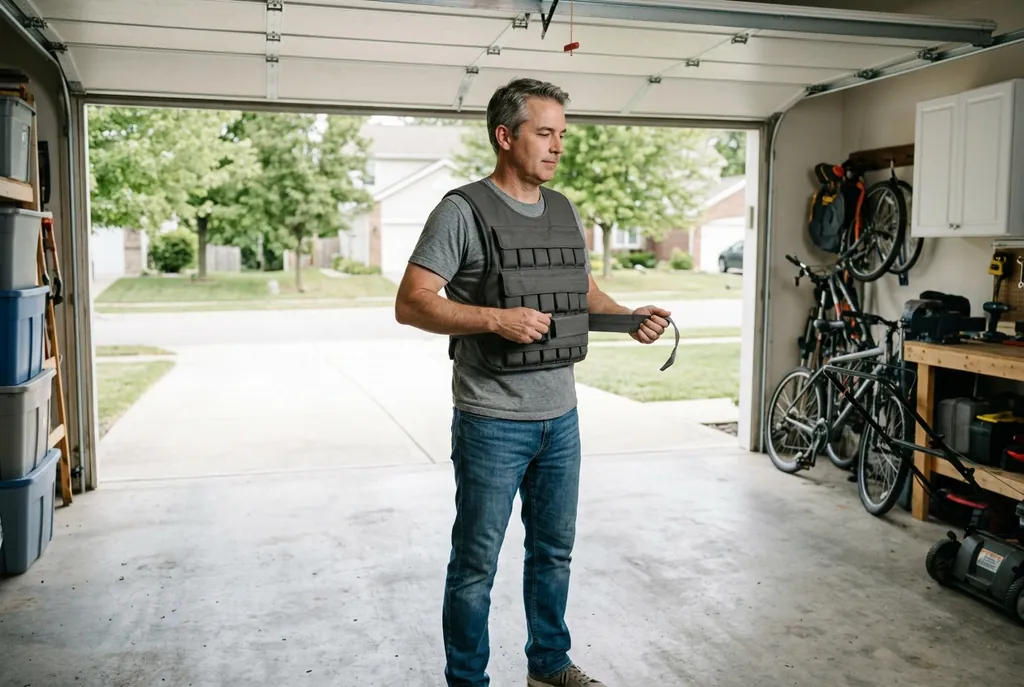
Man adjusting the side straps of a weighted vest in a home garage
AI-generated illustrative image
  • Activity match: For walking and basic home training, soft adjustable vests are usually enough. For Murph-style workouts and gym conditioning, plate carriers make more sense. For strict weighted pull-ups, dips, and heavier lower-body work, look at higher-capacity pocket vests or plate-loaded designs.
  • Practical load vs. max capacity: Do not buy around the biggest number on the page. For walking, a vest with a moderate ceiling is usually enough because most people should stay around 5–10% of body weight [1][2][3]. For Murph, the practical target is the event standard. For heavy calisthenics, buy slightly above your real planned ceiling, not far beyond it.
  • Increment size: Smaller steps matter. Hyperwear’s 2.25-ounce inserts and Titan’s 2.5-pound ingots are much easier to progress with than plate carriers that jump in larger fixed steps.
  • Fit information: Published chest sizing is a major advantage, especially if you have a shorter torso, a larger chest, or want a vest that sits high and close. If a brand does not publish measurements, treat fit as less predictable.
  • True setup cost: Some vests include all the weight; some ship empty and need proprietary or brand-specific plates. If you are price-sensitive, compare the all-in setup, not just the base vest.

For more detailed breakdowns, review our comprehensive buying guide and our specific breakdown on sizing & fit.

What is the best weighted vest for running for men?

Our house guidance does not recommend running in a weighted vest by default. If an experienced, pain-free runner still chooses to use one, keep the load to short segments and no more than 5% of body weight.

Within that narrow use case, both Garage Gym Reviews and BarBend name the Hyperwear ELITE their pick for running; BarBend credits its snug, next-to-skin fit with limiting bounce. Fit matters here because running with load increases leg stiffness and peak forces [5].

For most readers, though, the safer takeaway is simpler: do not confuse a vest’s close fit or high capacity with a green light for loaded running. Walking, incline work, and controlled strength sessions are the more sensible starting points.

Read our full analysis on running with a weighted vest for safety guidelines and proper pacing strategies.

Who makes the best weighted vest for men?

There is no single best brand across every use case.

Hyperwear is the best brand here for published fit range, small increments, and close-body fit. Rogue is the most logical brand for Murph-style plate-carrier training if you are comfortable buying plates separately. Titan is the stronger value for heavier included-weight setups up to 60 lb. Zelus is the simple budget path for walking and beginner use. OMORPHO is the niche pick for a slim, low-bulk feel.

Care and maintenance matter more than most buyers expect:

  • Wipe down the shell after sweaty sessions.
  • Remove inserts or plates before deeper cleaning if the maker instructs it.
  • Let the vest dry fully before storage.
  • Store it flat or supported so the shape and closures are not stressed.
  • Inspect straps, closures, seams, and weight pockets regularly, and stop using it if damage could let weight shift or fall out.

Sources

  1. UCLA Health (2025). Should you walk with a weighted vest? (expert: Sharon Hame, MD, orthopedic sports medicine).
  2. Mass General Brigham (2025). Do Weighted Vests Work? (expert: Sarah Eby, MD, PhD, sports medicine).
  3. Cleveland Clinic Newsroom (2026). The Do’s and Don’ts of Wearing Weighted Vests (expert: Jessica Tomazic, MD, sports medicine).
  4. Atlantic Health (2025). The Pros and Cons of Weighted Vests (expert: Bharav Patel, DPT).
  5. Silder A, Besier T, Delp SL (2015). Running with a load increases leg stiffness. J Biomech.